Wallace & Gromit: The Curse of the Were-Rabbit
Vibe
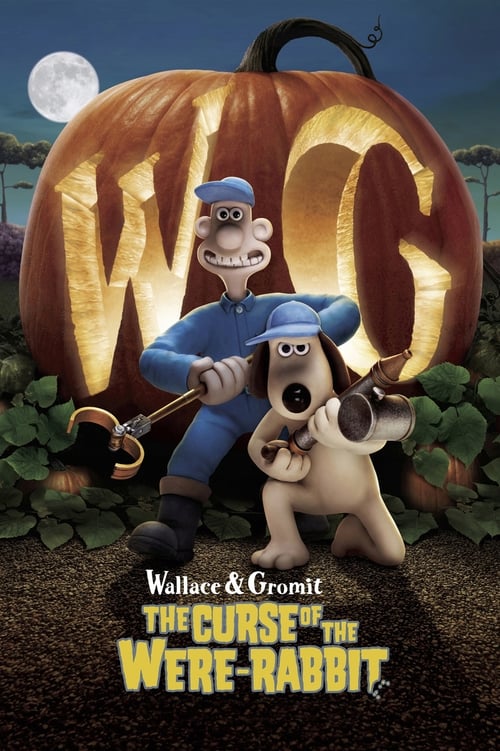
Wallace & Gromit: The Curse of the Were-Rabbit follows the lovable inventor and his long-suffering dog as their humane pest control business faces its greatest challenge: a colossal rabbit monster terrorizing a village obsessed with its annual Giant Vegetable Competition. An Aardman and DreamWorks co-production directed by Nick Park and Steve Box, the film is the warmest and most fully realized feature-length Wallace & Gromit story — a stop-motion monster-movie parody constructed with the painstaking physical craft that defines Aardman's work, operating on five levels of comedy simultaneously.
Watch for
- Gromit, who expresses everything through eyebrow position and body language alone and who is, across five levels of comedy simultaneously, the funniest character on screen.
- The stop-motion craft at its absolute peak — every fingerprint, tea towel, and hand-built set is visible, and the tactile physicality is fundamental to the comedy.
- The monster-movie parody running through the film, referencing King Kong and Universal horror with the affection of filmmakers who genuinely love those films.
- The climax atop a giant vegetable trophy — simultaneously a monster-movie finale, a romantic comedy resolution, and a slapstick setpiece.
- The film's social satire of British village life — the vegetable competition as proxy for local status, the class dynamics between Lady Tottington and Victor Quartermaine, the community's collective commitment to a cultural ritual that has consumed their emotional lives — which gives every scene a sociological grounding that pure genre parody would not have.
Production notes
Produced by Aardman Animations in Bristol with DreamWorks as co-producer and US distributor, the film took five years of development and production — an extraordinarily long timeline even by stop-motion standards. Nick Park created Wallace & Gromit in a 1989 student short; their three subsequent films — A Grand Day Out, The Wrong Trousers, and A Close Shave — each won or were nominated for Academy Awards, building worldwide affection before the feature was attempted. The physical production required several hundred crew members working simultaneously across multiple sets, building and lighting dozens of distinct environments while maintaining visual consistency across months of filming. Helena Bonham Carter and Ralph Fiennes voiced the aristocratic supporting characters, giving the film's British class comedy an additional layer through their own cultural personas. Every puppet, set piece, and prop was built by hand by Aardman's model-making team.
Trivia
- The film took approximately five years to produce; the stop-motion animation required several hundred crew members working simultaneously across multiple physical sets.
- Nick Park has described the Were-Rabbit concept as a genuine love letter to monster movies — he wanted the film to function as horror-comedy rather than simple parody.
- The film won the Academy Award for Best Animated Feature, defeating CGI competition and affirming that handmade stop-motion could still be the industry's best.
- Every physical puppet, set piece, and prop in the film was built by hand by Aardman's model-making team.
- The film's climax — atop a giant vegetable trophy in the middle of a moonlit night — required building and lighting a full-scale physical set that took weeks to construct and could only be used for a limited number of shots before the clay elements began to deteriorate under the production lights. Aardman's animators have described the sequence as among the most logistically complex in the studio's history.
Legacy
The Curse of the Were-Rabbit won the Academy Award for Best Animated Feature at the 2006 ceremony, defeating CGI competition from Chicken Little and Corpse Bride — an affirmation that handmade stop-motion animation could be the industry's best at the height of the CGI era. The film earned $192 million on a $30 million budget and is consistently ranked among the greatest animated comedies ever made. Its Academy Award win represented the animation industry's highest-level validation of Aardman as a studio — confirmation that the commitment to physical animation that had seemed commercially quixotic was, in creative terms, entirely justified. Nick Park's subsequent Aardman features were made possible by the credibility and commercial leverage this film generated.