Trolls
Vibe
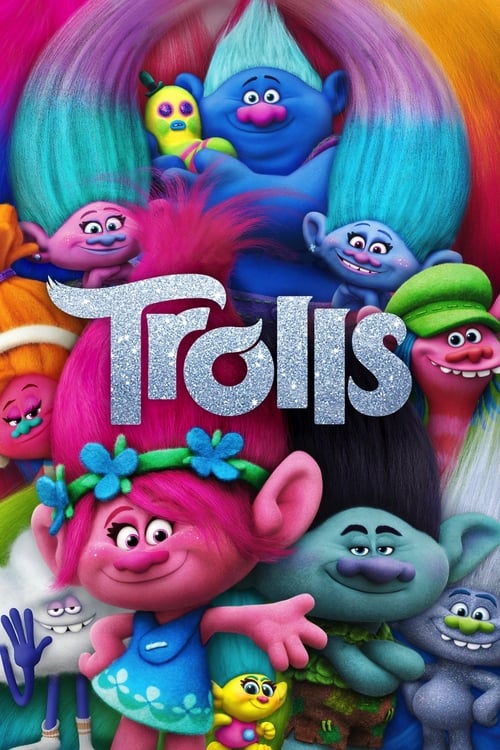
Trolls follows Princess Poppy, relentlessly optimistic ruler of the Trolls, and Branch, her cynical neighbor who has never sung or hugged anyone, as they travel to Bergen Town to rescue their friends before they are eaten at the Bergens' happiness festival. Directed by Mike Mitchell and Walt Dohrn, the film is a joyful, aggressively colorful musical comedy about the difference between happiness as performance and happiness as genuine feeling — a theme earnest enough to work because the film commits to it completely rather than hedging toward irony.
Watch for
- The film's visual design, which treats everything as if made from craft materials — felt, glitter, yarn, construction paper — giving it a handmade aesthetic that distinguishes it from any other DreamWorks Animation release.
- Anna Kendrick and Justin Timberlake's vocal chemistry, which drives the central odd-couple relationship.
- The musical sequences, which range from original songs to reimagined pop hits that serve the story rather than interrupting it.
- Branch's arc, which reveals that his cynicism is grief in disguise — a more emotionally specific characterization than the cheerful vs. gloomy premise suggests.
- The Bergen town storyline — in which an entire civilization is built around the belief that happiness is something you can only obtain from outside yourself — which the film treats as a genuine philosophical error rather than simply a villain motivation, allowing its resolution to function as a discovery rather than a defeat and giving the comedy a more considered thematic argument than the premise suggests.
Production notes
The Trolls were originally created by Danish woodcarver Thomas Dam in 1959; the dolls became global toy phenomena in multiple waves across following decades. The film developed a visual aesthetic specifically designed to resemble craft materials — felt, glitter, yarn, sequins, cotton balls — with the production team creating physical prototypes of every element out of actual craft supplies before translating them into CGI, giving the digital environments an unusually tactile quality. Justin Timberlake served as executive music producer — selecting, producing, and recording the film's musical content — and voiced Branch, making this his first time combining production and performance roles on a studio animated feature. Branch's cynicism revealed as grief in disguise was identified early in development as the film's emotional spine, giving the musical comedy a more serious underlying current than the premise suggested.
Trivia
- Justin Timberlake served as executive music producer and voiced Branch — the first time he combined both roles on a studio animated feature.
- The film's visual aesthetic was developed by the art team making actual physical craft prototypes out of felt, glitter, and yarn before translating them into CGI.
- The original Troll dolls, created by Danish artist Thomas Dam in 1959, have had multiple waves of commercial popularity — the film's development coincided with their latest resurgence.
- Trolls earned $346 million worldwide and spawned a franchise of sequels and spin-offs that became one of DreamWorks Animation's most reliable commercial properties.
- The film's color palette was designed to shift dynamically with the emotional state of the story — the Troll world saturated and vivid when happiness is genuine, washed out when it is performed or absent, and the Bergen world beginning monochromatic and gradually gaining color as the narrative progresses. The production team developed a specific color temperature system for tracking the film's emotional register visually throughout production.
Legacy
Trolls earned $346 million worldwide and launched one of DreamWorks Animation's most commercially durable franchise properties in the streaming era — its sequels extended the franchise's commercial life into new distribution forms and musical content. Justin Timberlake's involvement as executive music producer gave the film cultural credibility in the contemporary music world that most animated features cannot access. The craft-material visual aesthetic remains distinctive in the animated film landscape and has become the franchise's most immediately recognizable characteristic.