The Prince of Egypt
Vibe
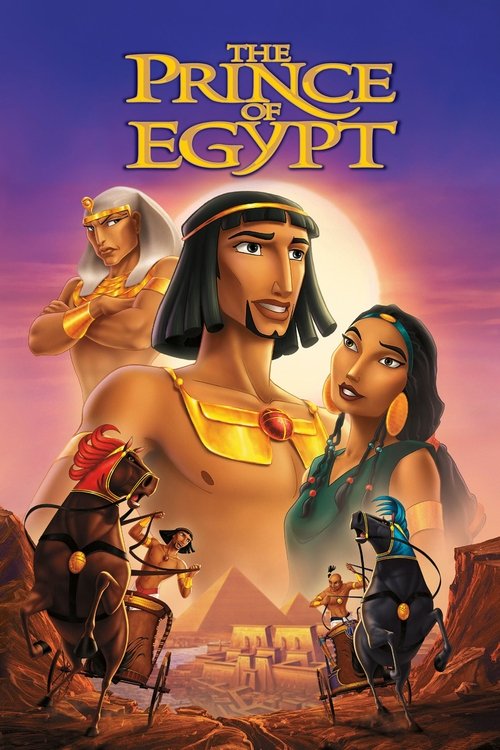
The Prince of Egypt retells the Exodus story with Moses and Rameses at its center — not as hero versus villain from birth, but as brothers whose bond is shattered by history and divine calling. Directed by Brenda Chapman, Steve Hickner, and Simon Wells, it is the most emotionally serious film DreamWorks Animation ever produced: a hand-drawn epic that consulted over 600 religious scholars to earn its biblical weight, and whose parting of the Red Sea sequence remains one of the most spectacular achievements in the history of the medium.
Watch for
- The parting of the Red Sea — three years of production, hundreds of animators, and pioneering 2D-CGI integration to render water at a scale the medium had never attempted.
- The dynamic between Moses and Rameses, treated as a genuine tragedy between people who loved each other rather than a simple moral binary.
- Hans Zimmer's score and Stephen Schwartz's songs, which carry the film's theology and emotion without stopping the story.
- The cave painting sequence, compressing the history of slavery into abstract, painterly imagery — one of the film's most formally inventive passages.
- The film's opening sequence — slaves at labor beneath the title, scored to 'Deliver Us,' the camera moving through their suffering with the slow deliberateness of a historical document — which announces immediately that this will be a different kind of animated film, one that has decided to honor its subject matter rather than soften it for family audiences.
Production notes
DreamWorks consulted with over 600 religious scholars, theologians, and community leaders across Judaism, Christianity, and Islam — an unprecedented consultation process that fundamentally shaped the screenplay's treatment of its source material. The Red Sea parting alone required approximately three years and hundreds of animators working across multiple studios, combining traditional hand-drawn animation with early CGI water simulation to render scale that had never been attempted in the medium before. Stephen Schwartz wrote the songs after being challenged to make them feel as if they could have emerged from the tradition of the story rather than from a Broadway songbook. Whitney Houston and Mariah Carey, who at the time were publicly at odds, agreed to record 'When You Believe' together at Katzenberg's personal request — the session was reportedly tense but productive, and the single reached number one in multiple countries. The film's $70 million budget made it the most expensive traditionally animated feature ever produced at the time of its release.
Trivia
- Val Kilmer voices both Moses and the voice of God — a deliberate choice suggesting that the divine voice Moses hears is in some sense a reflection of himself.
- Jeffrey Katzenberg screened a rough cut for Pope John Paul II at the Vatican; the Pope reportedly expressed his approval.
- 'When You Believe' by Whitney Houston and Mariah Carey reached number one in multiple countries.
- The film was the most expensive traditionally animated feature ever made at the time, at approximately $70 million.
- The film's final shot — Moses descending from Sinai carrying the Ten Commandments, the camera pulling back to reveal the assembled Israelites — was among the last sequences completed, and the production team has described it as one of the most difficult frames to get right: it needed to honor the scale of what had just happened without tipping into triumphalism or sentimentality.
Legacy
The Prince of Egypt earned $218 million worldwide on a $70 million budget — at the time the most expensive traditionally animated feature ever produced — and won the Academy Award for Best Original Song for 'When You Believe.' It remains the high-water mark of DreamWorks Animation's hand-drawn era and the most ambitious animated biblical epic ever made. No subsequent animated film has attempted to engage with the Exodus story at this scale or with this degree of theological seriousness, and the production's consultation process with scholars across three faiths set a standard for cultural and religious respect that the animation industry has rarely matched. The Parting of the Red Sea is regularly cited in animation history as one of the medium's great technical and artistic achievements — a sequence that required the full resources of both traditional and digital animation to realize what had previously been impossible to depict.