Spirit: Stallion of the Cimarron
Vibe
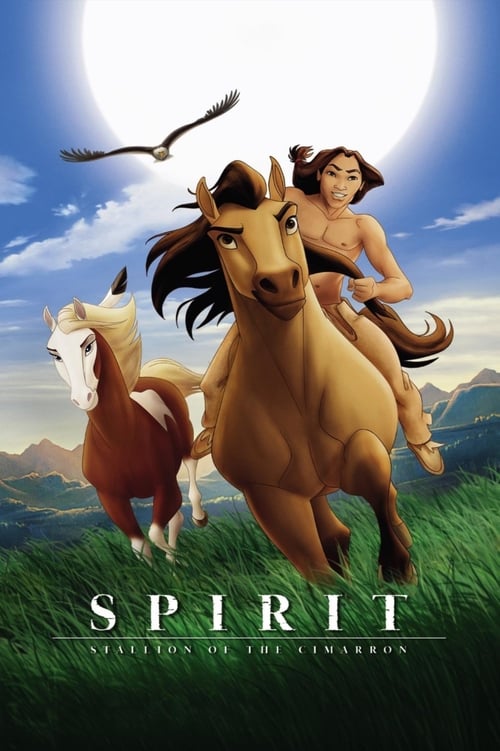
Spirit: Stallion of the Cimarron follows a wild mustang captured by the U.S. Cavalry and subjected to repeated attempts to break him, told almost entirely from the horse's perspective through body language, Hans Zimmer's score, and Bryan Adams's songs rather than dialogue. Directed by Kelly Asbury and Lorna Cook, the film is one of DreamWorks Animation's most formally inventive productions — a non-verbal narrative about freedom and colonialism that trusts its audience to read emotion through physical performance and composition alone.
Watch for
- The film's commitment to the horse's point of view in both framing and storytelling — most of the emotional content is carried through physical animation rather than words.
- The visual rendering of the American West, blending traditional 2D animation with CGI landscapes to achieve a genuinely painterly, wide-open quality.
- Hans Zimmer's orchestral score doing most of the film's emotional heavy lifting across long wordless passages.
- The subtext about Manifest Destiny and Native displacement — present and legible without ever becoming didactic.
- The sequence in which Spirit endures the Colonel's systematic breaking attempts and refuses each one — shot as a series of increasingly exhausting confrontations in which Spirit's will is his only remaining resource — which the film presents not as triumphalism but as the straightforward cost of remaining free in a world determined to end that freedom.
Production notes
The film used a hybrid technique combining hand-drawn horse animation with CGI environments, allowing the landscapes of the American West to have depth and scale impossible through traditional 2D means while preserving the warmth and tactile quality of hand-drawn character performance. Animators worked with horse behaviorists extensively enough to replicate equine movement at 24 frames per second — a commitment that gives the film's performances a physical authenticity unusual in animation. Bryan Adams wrote and recorded his songs while watching rough animation cuts, designing lyrics to respond to specific emotional beats on screen rather than writing generically to the film's themes. The subtext about Manifest Destiny and the displacement of Indigenous peoples runs consistently through the film without ever emerging as explicit dialogue — a deliberate choice to honor historical complexity without turning the film into a lecture. The hybrid production technique was also one of the last attempts by DreamWorks Animation to sustain traditional hand-drawn character work alongside CGI environments before fully transitioning to all-digital production.
Trivia
- Every horse in the film was animated by hand rather than motion-captured — animators studied equine behavior intensively enough to replicate it at 24 frames per second.
- Bryan Adams composed his songs while watching rough animation, allowing the lyrics to respond directly to the specific emotional beats on screen.
- The film contains almost no animal dialogue beyond brief narration — a deliberate choice that forced all emotion to be conveyed through physical performance.
- Spirit was one of the last traditionally animated features DreamWorks Animation produced before the studio moved entirely to CGI.
- Spirit was shot to be experienced entirely from the horse's point of view — the camera almost never rises above the eyeline of an average horse, and human characters are viewed from below or at arm's length throughout. The production team formalized this constraint before beginning storyboarding, and it shaped every composition in the film, giving the human-imposed authority structures a specific visual weight they would not have from a neutral camera position.
Legacy
Spirit earned $122 million worldwide and received an Academy Award nomination for Best Animated Feature. It has retained a passionate following, particularly among viewers who first encountered it in childhood, and is regularly cited as one of the most emotionally direct animated films of its era. Its non-verbal narrative approach — trusting body language, score, and composition to carry emotional content that most films would have conveyed through dialogue — remains unusual in mainstream animation and gives it a contemplative quality that distinguishes it from virtually everything else the studio produced. The film holds a particular place in DreamWorks Animation's output as the last traditionally animated feature before the studio began its irreversible migration to CGI.