Sinbad: Legend of the Seven Seas
Vibe
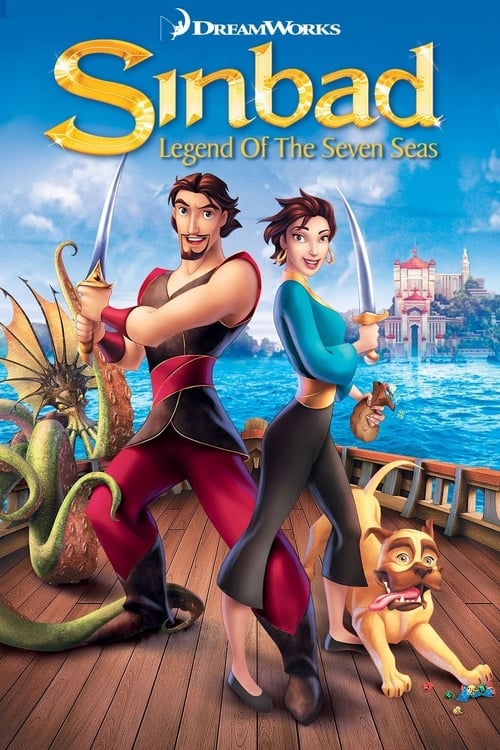
Sinbad: Legend of the Seven Seas follows the sailor framed by the goddess Eris for stealing the Book of Peace, with his childhood friend Proteus set to be executed unless Sinbad retrieves it from Tartarus in ten days. Directed by Patrick Gilmore and Tim Johnson, the film is a rollicking Mediterranean adventure that blends Greek mythology with the Arabian Nights tradition, anchored by an unusually combative and entertaining dynamic between Brad Pitt's Sinbad and Catherine Zeta-Jones's Marina.
Watch for
- The siren sequence, in which the crew is lured toward rocks by visions of the people they love most — a passage of rare emotional precision for an action setpiece.
- Eris, voiced by Michelle Pfeiffer, as one of DreamWorks Animation's sharpest antagonists — a chaos deity who operates through misdirection and wit.
- The visual palette shift between the warm Mediterranean world and the cold, surreal geometry of Tartarus.
- Marina's characterization as a competent equal to Sinbad — more capable than he is in several situations, and the film knows it.
- The film's genuinely tragic ethical resolution — Proteus willing to die for Sinbad not because he believes Sinbad will return but because he trusts the person Sinbad could become — a distinction the film makes clearly, giving the climax more moral weight than its adventure comedy genre would typically require.
Production notes
One of the last traditionally animated DreamWorks features, Sinbad's commercial performance — roughly $80 million worldwide against a $60 million budget — was the final significant factor in the studio's decision to abandon hand-drawn animation entirely. The film's mythology deliberately blends Greek and Arabic traditions, reflecting the Sinbad legend's own multicultural origin as a character from the One Thousand and One Nights retold across centuries and cultures. Brad Pitt and Catherine Zeta-Jones recorded many of their scenes together rather than separately, an expensive choice the directors credited for the natural combative rhythm of Sinbad and Marina's exchanges. The Tartarus sequences required developing an entirely new visual language — geometric, cold, surreally still compared to the warm Mediterranean world — without the benefit of CGI environments, which traditional hand-drawn production could not accommodate at the required scale. Michelle Pfeiffer designed Eris's specific vocal quality as someone who has never needed to raise her voice because the threat is always implicit.
Trivia
- Sinbad's box office failure was one of the final factors in DreamWorks Animation's decision to abandon hand-drawn animation entirely.
- Brad Pitt and Catherine Zeta-Jones recorded their scenes opposite each other rather than separately — unusual for animation.
- The siren sequence required designing unique hallucination imagery for each individual crewmember.
- The film's mythology deliberately blends Greek and Arabic traditions, reflecting the Sinbad legend's own multicultural origins.
- Michelle Pfeiffer's Eris was designed as a character whose visual form is genuinely unstable — she shifts scale, melts into shadow, and distorts perspective in every scene she appears in. The traditional animation team developed specific techniques for suggesting dimensional instability within the constraints of a flat medium, treating Eris as an exercise in the formal possibilities of hand-drawn animation at its most expressive.
Legacy
Sinbad was a commercial disappointment that nonetheless holds a cult following for its visual ambition, Michelle Pfeiffer's sharply drawn antagonist, and its unusually capable female lead in Marina. More than any other single film, its box office failure accelerated DreamWorks Animation's complete transition to CGI — the studio announced within months that it would not produce another traditionally animated feature. For animation historians, Sinbad stands as the end of an era: the last gasp of a studio that had produced some of the finest hand-drawn animation of the 1990s, abandoned at the moment the medium was being displaced in mainstream commercial production. The film's craftsmanship — its painterly backgrounds, its fluid character animation — is visible enough on revisiting to make the loss of the format feel genuinely mournable.