Shrek Forever After
Vibe
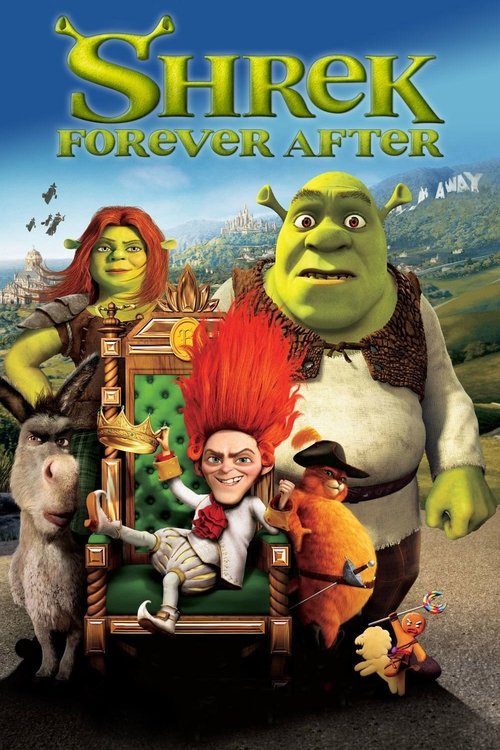
Shrek Forever After finds Shrek in a domestic midlife crisis and tricked by Rumpelstiltskin into signing away the day he was born — creating an alternate timeline where he never existed and Far Far Away is a darker, more oppressive kingdom ruled by fine-print contracts. Directed by Mike Mitchell, the film is the most melancholy and introspective entry in the franchise, structured around the question of whether the ordinary life you have is truly the life you want — a premise that the film, to its credit, pursues honestly rather than treating as a setup for reassurance.
Watch for
- The alternate-timeline Far Far Away, which is ruled by Rumpelstiltskin and has the visual language of a fairy-tale dystopia.
- Fiona as a hardened resistance leader in the alternate timeline — Cameron Diaz's most interesting version of the character since the first film.
- Rumpelstiltskin as a villain whose antagonism operates through contract law rather than brute force — a cleverer antagonist concept than most Shrek sequels managed.
- The film's final act, which commits fully to its emotional logic and delivers a conclusion more affecting than the third film.
- The alternate-timeline Fiona — a resistance leader who chose fighting over waiting, harder-edged and more explicitly capable than the Fiona of the main timeline — which suggests that the person Fiona might have become without the ogre curse was more interesting rather than less, a complication the film introduces without fully resolving and is more honest for leaving open.
Production notes
Produced as a deliberate final chapter, with the creative team committing to engage seriously with what the franchise's themes actually mean to a character who has spent three films learning to accept himself and must now confront whether he values what he has accepted. Walt Dohrn, who plays Rumpelstiltskin, was the film's head of story rather than a professional actor — he was cast after performing the character in a story meeting and being told his instinctive characterization was the definitive version. The filmmakers screened It's a Wonderful Life repeatedly at the start of development to establish the emotional and structural logic they wanted the alternate-timeline device to serve. The production specifically committed to giving Fiona an arc in the alternate timeline that would show the audience what she was capable of when circumstances required it — her role as resistance leader was designed to be more than decorative.
Trivia
- The filmmakers screened It's a Wonderful Life multiple times at the start of development to establish the emotional and structural logic of the alternate timeline.
- Walt Dohrn, who plays Rumpelstiltskin, was the film's head of story — he was cast after performing the character in a story meeting.
- The film was marketed as 'the final chapter' of the Shrek saga, though subsequent spin-offs and a fifth film in development have complicated that.
- Shrek Forever After earned $752 million worldwide — a solid performance that the studio considered a successful franchise closer.
- The film's opening sequence — depicting Shrek's mundane domestic routine, the baby shower and community events and endless repetition that has made him feel trapped — required designing a montage of domestic specificity that would make the audience understand his restlessness as legitimate rather than ungrateful. The production team consulted with psychologists studying midlife transition to ensure the character's emotional arc was grounded in recognizable experience rather than generic middle-age comedy.
Legacy
Shrek Forever After earned $752 million worldwide and is considered a respectable and underappreciated conclusion to the original quadrilogy — a film whose melancholy premise and willingness to engage with regret, domesticity, and the value of an ordinary life give it a gravity that its position as fourth franchise entry tends to obscure. The alternate-timeline device, borrowed from It's a Wonderful Life, worked better in the animated context than critics expected because Shrek's specifically embodied existence — his green skin, his size, his swamp — could be meaningfully removed in ways that convey genuine loss. It remains the most emotionally complete ending the Shrek story has received.