Shrek
Vibe
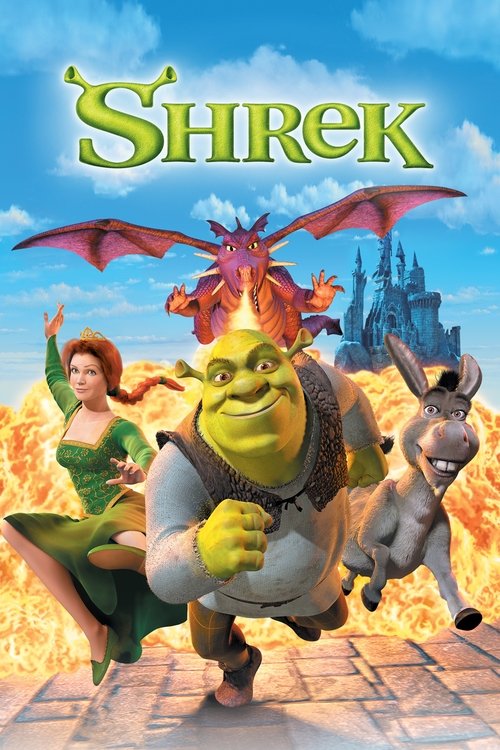
Shrek follows a solitary ogre who wants nothing more than his swamp back and finds himself on a quest to rescue a princess he didn't ask for, escorted by a donkey he can't get rid of, in a world built entirely from deconstructed fairy-tale conventions. Directed by Andrew Adamson and Vicky Jenson, the film was DreamWorks Animation's defining statement — a broad, irreverent parody of Disney that nonetheless found genuine emotional depth in characters who believe they are too ugly or too odd to be loved. It won the first-ever Academy Award for Best Animated Feature and changed the aesthetic of popular animation for a decade.
Watch for
- The film's sustained parody of Disney conventions — the princess, the castle, the fairy tale ending — used as scaffolding for a story about self-acceptance.
- Mike Myers, Eddie Murphy, and Cameron Diaz's performances, which keep the comedy grounded in character rather than pure sketch energy.
- The moment the film pivots from parody to sincerity — and how it earns that pivot by building genuine affection across the first two acts.
- The CGI animation, which was state-of-the-art for 2001, particularly in cloth simulation, fur, and facial performance.
- Fiona's arc — her decision, made long before she met Shrek, to find a way to live with who she was — revealed in the third act as a backstory that reframes the entire rescue narrative: she was not waiting to be saved, she was waiting to be seen, and the film understands the difference.
Production notes
Based on William Steig's 1990 picture book, the project was shaped fundamentally by Katzenberg's acrimonious 1994 departure from Disney and developed as an explicit artistic counterpoint to Disney's animated fairy tales. Chris Farley recorded nearly all of Shrek's dialogue before his death in December 1997; Mike Myers replaced him from scratch, re-recording every line, and later added the Scottish accent after his first natural-voice pass felt insufficiently distinct. The CGI rendering was state-of-the-art for 2001, requiring breakthrough approaches to cloth simulation, fur dynamics, and facial performance — Shrek's face was capable of an unprecedented range of nuanced expression for a CGI character. The technical pipeline developed for Shrek became the foundation of DreamWorks Animation's digital production process for the following decade, and PDI's full maturation as a feature-quality studio was demonstrated definitively by this production.
Trivia
- Chris Farley recorded nearly all of Shrek's dialogue before his death in December 1997; Mike Myers replaced him from scratch and added the Scottish accent.
- Shrek won the first-ever Academy Award for Best Animated Feature in 2002, widely seen as a deliberate industry choice to reward the anti-Disney film over Monsters, Inc.
- Lord Farquaad was widely rumored to be a caricature of Disney CEO Michael Eisner; the filmmakers denied it but acknowledged John Lithgow's performance played into certain archetypes.
- The film's pop music score was a deliberate aesthetic statement against Disney's orchestral fairy-tale tradition.
- The film's fairy-tale characters who appear in the opening sequence — Pinocchio, the Three Little Pigs, the Gingerbread Man — were all developed as potential franchise supporting characters from the beginning, with extensive character work done on each before the writers determined which ones would have prominent roles in future installments.
Legacy
Shrek earned $484 million worldwide on a $60 million budget and won the first-ever Academy Award for Best Animated Feature — widely perceived as a deliberate industry statement rewarding work outside Pixar, particularly after Monsters, Inc. had been considered the frontrunner. The film spawned three direct sequels, a spin-off franchise, a Broadway musical, and one of the most recognizable animated characters in global popular culture. Its aesthetic — irreverent, pop-saturated, fairy-tale conventional on the surface and emotionally sincere underneath — defined the visual and tonal vocabulary of mainstream commercial animation for the better part of a decade, influencing virtually every animated studio blockbuster that followed. Shrek's face is among the most widely recognized animated character designs ever created.