Shark Tale
Vibe
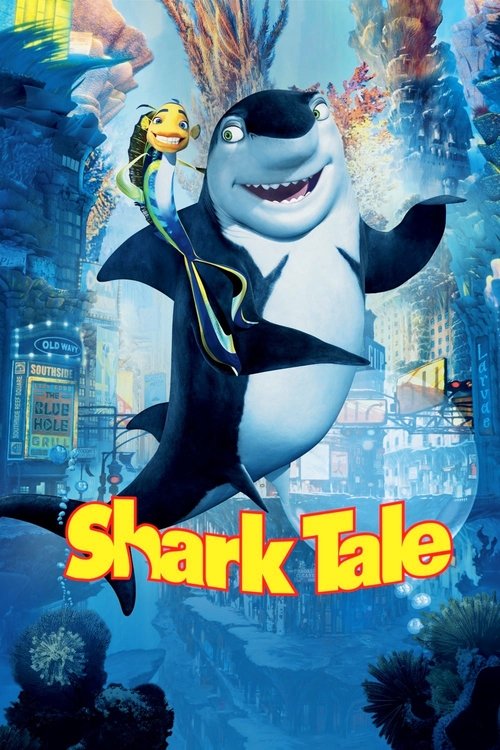
Shark Tale follows Oscar, a nobody reef fish who stumbles into fame by claiming credit for killing a shark, in an underwater world designed as a neon-lit city that parodies gangster films — The Godfather and Goodfellas most explicitly. Directed by Vicky Jenson, Bibo Bergeron, and Rob Letterman, the film is a hip-hop-saturated urban comedy with a strong voice cast (Will Smith, Jack Black, Robert De Niro, Angelina Jolie) and considerable visual invention in its world-building, even where the story mechanics feel mechanical.
Watch for
- The underwater city's dense design, which recreates human metropolitan life — billboards, nightclubs, streets, restaurants — entirely in marine aesthetics.
- Robert De Niro as Don Lino, playing affectionately with his own real-world gangster film legacy.
- Jack Black as Lenny, a vegetarian shark who wants nothing to do with mob life — the film's most genuinely felt character arc.
- The hip-hop cultural integration, which permeates the soundtrack, dialogue, and character design in ways that give the film a distinctive personality.
- The film's unexpectedly sincere treatment of Lenny's coming-out narrative — a vegetarian shark who cannot be what his father needs him to be — which sits in the film like a genuine emotional story that the pop-culture surface occasionally allows to surface, giving the comedy a moral dimension it does not always acknowledge it has.
Production notes
Shark Tale was produced simultaneously with Shrek 2, making 2004 DreamWorks Animation's most ambitious production year to that point, and was a deliberate attempt to create a film targeting an older, urban demographic. The filmmakers worked directly with hip-hop artists and producers to develop an authentic sonic world, resulting in original recordings from Will Smith, Missy Elliott, Christina Aguilera, and Ludacris alongside a score blending orchestral elements with contemporary hip-hop production. New rendering techniques were developed specifically for the film to simulate caustic underwater light — the patterns of refracted light near the surface of a body of water — which had not been attempted at feature film quality in CGI. The production team created over 200 distinct species of coral, plant life, and marine organisms to populate the reef city's background, giving the film a visual density that rewards close attention. The production alongside Shrek 2 demonstrated that DreamWorks Animation could operate as a multi-film production entity simultaneously.
Trivia
- Will Smith co-wrote and recorded several songs for the soundtrack in addition to voicing Oscar.
- Robert De Niro was cast partly as a running joke about his real-world gangster film legacy — his performance winks at that history throughout.
- The film earned $367 million worldwide despite mixed reviews, demonstrating the commercial power of the DreamWorks Animation brand in 2004.
- The production team created over 200 distinct species of coral, plant life, and marine animals to populate the background of the reef city.
- The reef city's architecture was designed as a direct translation of a specific New York City neighborhood — the Heights area of Manhattan — transposed into an underwater environment, with each building and street block based on actual locations. The production design team photographed and mapped the neighborhood before beginning the digital translation, ensuring the spatial relationships felt coherent rather than generically urban.
Legacy
Shark Tale earned $367 million worldwide and remains commercially successful despite its mixed critical reception. It holds a specific cultural place as one of the most ambitiously hip-hop-influenced mainstream animated films ever produced — a film that treated contemporary Black and Latino urban culture as its primary aesthetic reference rather than as a source of easily assimilated surface gags. Whatever its narrative weaknesses, the attempt to bring a genuinely different cultural world into the animated blockbuster format was notable in a market dominated by the European fairy-tale aesthetic of Shrek and the anthropomorphized-nature films that filled the rest of the field.