Over the Hedge
Vibe
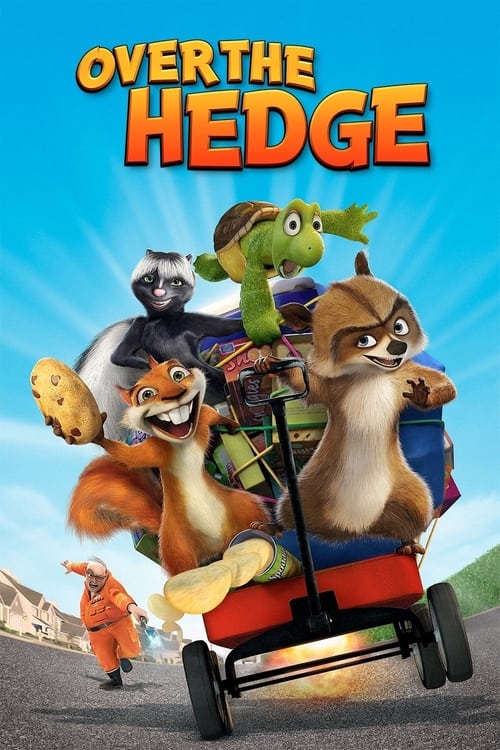
Over the Hedge follows RJ, a fast-talking raccoon who manipulates a group of newly awoken forest animals into helping him replenish a bear's stolen food supply by raiding the suburban development that consumed their forest. Directed by Tim Johnson and Karey Kirkpatrick, the film is a sharper suburban satire than its family comedy packaging suggests — RJ's extended monologue about how human consumer culture is organized entirely around food is one of the funniest and most pointed sequences in DreamWorks Animation's catalog.
Watch for
- RJ's tour of the suburb explaining that human civilization is organized entirely around acquiring and consuming food — a speech that is both very funny and completely accurate.
- Hammy the squirrel (Steve Carell), operating at a comedic register so extreme it constitutes its own self-contained joke throughout the film.
- The visual contrast between the organic forest and the sterile geometry of the suburb — design choices doing real thematic work without announcing themselves.
- The third act's comedic chaos, which accelerates without losing track of character relationships.
- RJ's eventual honesty with the group — confessing his original deception and accepting the consequences — handled with the specific emotional texture of someone who has spent his life alone discovering that belonging requires exactly the kind of vulnerability he has spent his life avoiding.
Production notes
Based on the long-running newspaper comic strip by Michael Fry and T Lewis, which has run continuously since 1995. The film presented a significant adaptation challenge — translating a single-panel, observation-based strip into a feature-length narrative required inventing a plot capable of honoring the strip's tone of suburban satire while providing enough kinetic content to justify 90 minutes. Ben Folds composed and performed original songs — a distinctive choice that brought an indie rock sensibility to the music rather than the orchestral family-film score most comparable productions would have used. The suburban cul-de-sac was designed in unusually specific detail, with the production team researching actual suburban development patterns and homeowners association aesthetics to populate the environment with recognizable specificity. Steve Carell's improvisational contribution to Hammy's dialogue was particularly significant — many of the character's most memorable moments originated in riffing within established scene parameters.
Trivia
- Steve Carell improvised much of Hammy's dialogue within the established character parameters — many of Hammy's most memorable lines were his own contributions.
- Ben Folds wrote an original score and songs for the film, marking one of the more distinctive musical choices in DreamWorks Animation's catalog.
- The film opened the same weekend as Pixar's Cars, performing respectably but being significantly outgrossed.
- The strip the film is based on has run continuously since 1995 and continues to this day.
- The sequence in which RJ narrates that human civilization is organized entirely around acquiring, storing, preparing, and consuming food was the scene that attracted the film's major stars when they first read the script. The directors have described it as the moment the film's satirical ambition became legible, and it remained one of the most quoted passages in early audience response.
Legacy
Over the Hedge earned $336 million worldwide and is regularly cited as one of DreamWorks Animation's better mid-period comedies — a film that executes its suburban satire with more precision and wit than the franchise-driven productions of the same period. Its critique of consumer culture and suburban development has aged with increasing rather than decreasing relevance, and the film's willingness to embed its ecological argument in comedy rather than sentiment gives it a satirical edge that more earnest environmental films often sacrifice. Ben Folds's score remains one of the most musically distinctive soundtracks in the studio's catalog.