Mr. Peabody & Sherman
Vibe
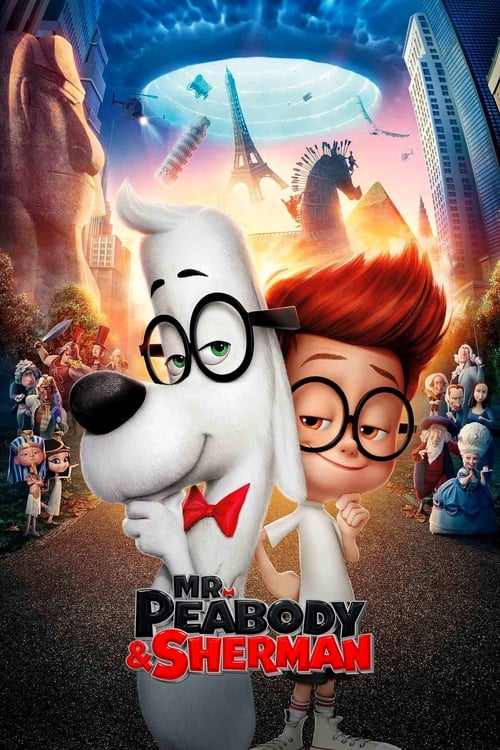
Mr. Peabody & Sherman follows the genius dog and his adopted boy as a malfunction of their time-travel machine, the WABAC, sends them careening through history while also dealing with a social worker's threat to take Sherman away from his unconventional parent. Based on the Jay Ward cartoon characters, the film is an affectionate and genuinely witty comedic adventure directed by Rob Minkoff — lighter in tone than most DreamWorks Animation productions of the period, with a pace and comic sensibility closer to classic animated shorts than to feature-length blockbusters.
Watch for
- The historical set pieces, each lovingly designed to a specific period — Ancient Egypt, Renaissance Florence, the Trojan War — and each milked for its maximum comic potential.
- Ty Burrell's performance as Mr. Peabody, which commits fully to the character's mixture of pompous genius and genuine parental devotion.
- The film's warmth about non-traditional family structures — Mr. Peabody is a dog who adopted a boy, and the film treats that as worthy of the same emotional stakes as any other parent-child relationship.
- The dense layering of historical puns and anachronistic comedy, which rewards attentive viewing.
- The film's climax, in which accumulated paradoxes from the WABAC's misuse begin tearing history apart and require every character introduced across multiple time periods to converge in present-day New York — a finale that commits fully to the absurdist implications of its own time-travel rules in a way that rewards the audience for having followed the film's internal logic.
Production notes
Based on the Peabody's Improbable History segments from The Rocky and Bullwinkle Show — roughly three-minute episodes that ran from 1959 to 1964 — developing them into a feature-length narrative required Rob Minkoff and his writing team to invent entirely new structural scaffolding: a present-day emotional arc, an antagonist, and a climax with real stakes, all built around characters designed for rapid-fire puns rather than sustained drama. Minkoff, who had previously directed The Lion King, was drawn specifically by the father-son dynamic between Peabody and Sherman, which he identified as the emotional core capable of supporting a feature. Ty Burrell's performance as Mr. Peabody — pompous, brilliant, genuinely loving — required finding the specific register where absolute confidence in one's own judgment coexists with deep vulnerability about whether that judgment is adequate for parenthood.
Trivia
- The original Peabody's Improbable History segments ran for roughly three minutes each — developing them into a feature-length story required entirely new structural scaffolding.
- Rob Minkoff, who directed The Lion King, was attracted to the project by the father-son dynamic between Peabody and Sherman.
- The film's time-travel comedy was deliberately structured to require no knowledge of the original cartoon, making it accessible to audiences who had never encountered the source material.
- Mr. Peabody & Sherman earned $275 million worldwide — modest given its $145 million budget but a respectful result for a property with limited modern pre-awareness.
- The film's historical set pieces required designing complete physical environments for five distinct periods — Ancient Egypt, the Renaissance, the French Revolution, ancient Troy, and present-day New York — with specific costume, architecture, and cultural detail. The production team worked with historians to ensure specific anachronisms would be genuinely funny to people with historical knowledge rather than simply being generic 'old times' settings.
Legacy
Mr. Peabody & Sherman earned $275 million worldwide and introduced a new generation to characters dormant for decades — an act of brand revival that succeeded on creative terms if not fully on commercial ones. The film is regularly cited as one of the more charming and underappreciated DreamWorks Animation productions of the 2010s — lighter and more playful in its comedy, and more unusual in its father-son emotional dynamic than the studio's larger productions. Rob Minkoff's directorial touch — the same sensibility that made The Lion King emotionally effective — is visible in how the film handles Peabody's vulnerability about whether his unconventional family is adequate.