Megamind
Vibe
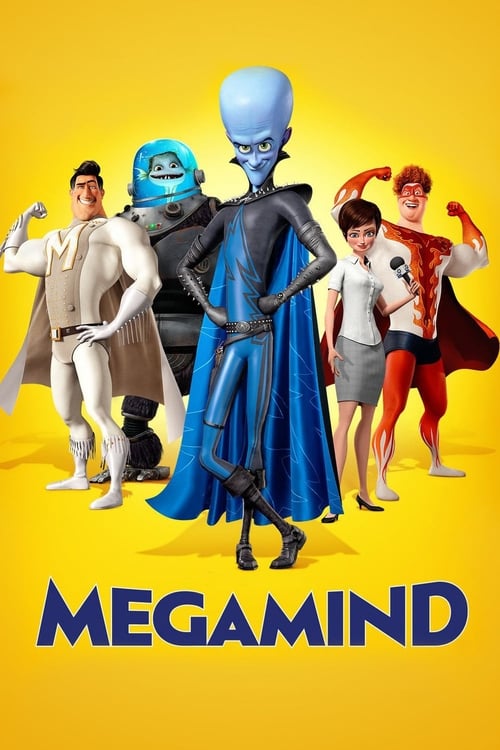
Megamind follows a blue-skinned supervillain who has been losing to his nemesis Metro Man since childhood — until the day he accidentally wins and discovers that a world without a hero to fight is a world without meaning. Directed by Tom McGrath, the film is a sharply witty superhero deconstruction that uses the villain's perspective to ask what happens when the structure that gives your life its shape collapses, and Will Ferrell's theatrical, self-aware performance as Megamind manages to be broadly comedic and genuinely emotional simultaneously.
Watch for
- Will Ferrell's vocal performance as Megamind, theatrical and self-aware and yet somehow sincerely moving when the film asks for it.
- The central question — what does a villain do when he wins? — followed through to its logical consequences rather than simply used as setup.
- Tighten as a secondary villain, whose arc is a pointed commentary on what ordinary resentment looks like when suddenly given unlimited power.
- The film's affectionate relationship to superhero genre conventions, deconstructed from the villain's perspective rather than the hero's.
- The film's treatment of Metro Man's secret decision — his choice to abandon heroism after a lifetime of performing it — which Megamind discovers but chooses not to expose, a moment of unexpected generosity that the film uses to mark Megamind's genuine moral transformation without announcing it as such or requiring a conventional redemption scene.
Production notes
Produced in the same year as Universal's Despicable Me, which had a similar sympathetic-supervillain premise, sparking industry discussion about two competing studios arriving at nearly identical concepts independently — a situation that had previously occurred with DreamWorks and Pixar's competing ant films in 1998. Brad Pitt was specifically cast as Metro Man to play a character exhausted by a lifetime of performed heroism — his performance choice was to make Metro Man sound genuinely tired of being good, a deliverable subtlety that gives the character's eventual disappearance a more complex moral dimension than a simple villain-wins scenario. Tom McGrath brought his ensemble comedy sensibility to the superhero genre deconstruction, ensuring the film's philosophical examination of villainy never overwhelmed its comedy. The decision to make Megamind's arc end somewhere between villain and conventional hero — rather than completing a full redemption — was made relatively late in development and significantly improved the film's thematic consistency.
Trivia
- Megamind and Despicable Me both released in 2010 with similar premises — two competing studios arriving at the same concept independently sparked significant industry discussion.
- Ferrell based Megamind's theatrical voice on a combination of Vincent Price and his own observations of performative villainy.
- Brad Pitt plays Metro Man as exhausted by heroism — a character who has been performing goodness his entire life and is fundamentally tired of it.
- The decision to make Megamind's arc end somewhere between villain and conventional hero — not a full transformation — was made relatively late in development.
- The film's central question — 'What does a villain do when there is no hero left to oppose him?' — was developed as a thought experiment by the screenwriters before any character design began. The question preceded the characters, which is why Megamind's identity crisis feels philosophically grounded: the story was built from the existential problem outward rather than from character traits inward.
Legacy
Megamind earned $321 million worldwide and has gained considerable critical reappraisal as a more philosophically interesting treatment of its villain-protagonist premise than its commercial competition. Despicable Me went on to spawn one of animation's most commercially successful franchises; Megamind remained a standalone film, and that isolation has actually served its reputation — revisited without franchise expectations, its willingness to take the villain's existential crisis seriously rather than treating it purely as comedic premise gives it a depth the Minions-era Despicable Me properties have not pursued. Will Ferrell's vocal performance is regularly cited as one of the underrated performances in animated film history.