Madagascar
Vibe
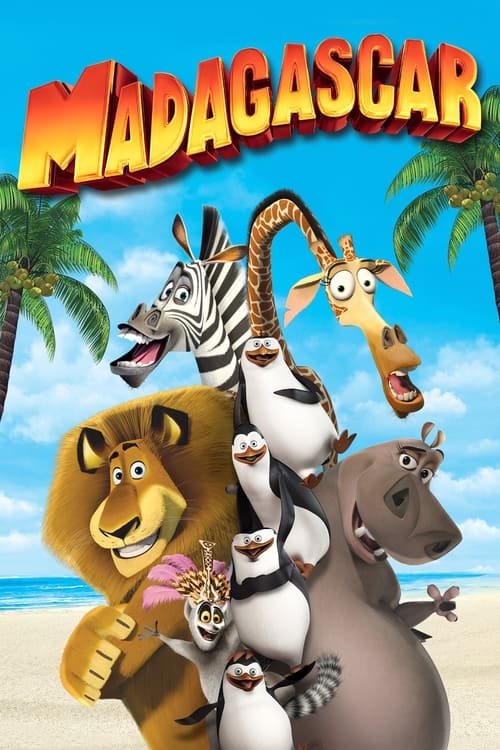
Madagascar follows four pampered Central Park Zoo animals — Alex the lion, Marty the zebra, Gloria the hippo, and Melman the hypochondriac giraffe — who are accidentally shipped off to the island of Madagascar and forced to confront what nature actually means when you've spent your life performing for an audience. Directed by Eric Darnell and Tom McGrath, the film is a fast, warm comedy about identity and belonging, anchored by a genuine central friendship and enlivened by a penguin subplot that became its own franchise.
Watch for
- The penguins in every scene they appear — their deadpan military competence and casual disregard for the main plot is the film's funniest running joke.
- Alex's internal struggle between predator instincts and loyalty to his friends — played for both comedy and genuine feeling.
- King Julien (Sacha Baron Cohen) and Maurice (Cedric the Entertainer), who arrive mid-film and immediately upstage everyone around them.
- The visual contrast between the zoo's artifice and Madagascar's wild density — each rendered in a different color temperature.
- The film's careful management of Alex's predator instincts — neither suppressed for family-film comfort nor indulged for easy menace — which makes his loyalty to Marty a choice with genuine cost, giving the central friendship more emotional weight than the broad comedy premise strictly requires.
Production notes
The first DreamWorks Animation feature to use a new internal system for more nuanced CGI facial performance, allowing animators to convey emotional states through micro-expressions and eye movement with previously impossible precision. The film introduced crowd simulation capable of rendering the zoo's visitors and Madagascar's lemur population as distinct individuals rather than repeating background elements. The penguins were originally minor comic relief; their response in test screenings was so dramatically outsized that the filmmakers added new scenes specifically for them and launched preliminary development on what would become The Penguins of Madagascar TV series and theatrical feature. Sacha Baron Cohen improvised substantial portions of King Julien's dialogue, creating a character whose philosophical pronouncements about lemur culture emerged largely from his own improvisational instincts within the established character parameters.
Trivia
- Sacha Baron Cohen improvised much of King Julien's dialogue, including several of his most absurdist pronouncements about lemur culture.
- The penguins were minor supporting characters until test screenings — their outsized audience response prompted the addition of new scenes and eventually spawned their own franchise.
- Bernie Mac voiced Zuba in Madagascar: Escape 2 Africa — the character was introduced in this film's concept before being developed in the sequel.
- The film earned $532 million worldwide and spawned two sequels, a spin-off film, and a long-running Netflix series.
- The Central Park Zoo depicted in the film's opening sequences was based on detailed photography and research visits to the actual zoo, with the production design team mapping specific enclosures, sight lines, and visitor areas before translating them into the slightly heightened cartoon aesthetic — ensuring that the specific pleasures of the zoo sequence would be recognizable to audiences who had been there.
Legacy
Madagascar earned $532 million worldwide and launched one of DreamWorks Animation's most commercially reliable franchises — a three-film main series, a theatrical spin-off, and a long-running Netflix series extending the franchise well into the 2020s. The penguins became globally recognizable characters entirely independent of the main cast, generating more dedicated fan activity and merchandise than any other Madagascar character. The film's warm central friendship between four fundamentally different animals — and its acknowledgment that such friendship requires something like active will rather than simple affinity — gives it an emotional logic that has kept it in regular rotation for family audiences across two decades.