Kung Fu Panda 4
Vibe
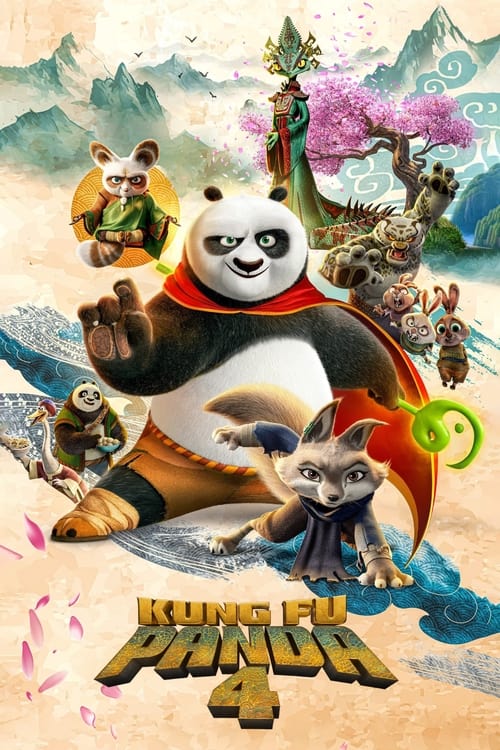
Kung Fu Panda 4 finds Po being asked to step into the role of Spiritual Leader of the Valley of Peace — requiring him to find and train a new Dragon Warrior — while a shape-shifting villain called the Chameleon attempts to resurrect the most powerful kung fu villains from the spirit realm. Directed by Mike Mitchell, the film is a lighter and more broadly comedic entry than the original trilogy while finding genuine new territory in Po's transition from hero to mentor — a character evolution that the franchise had been building toward since the beginning.
Watch for
- Po's transition arc — from fighter to teacher — which gives the franchise a fresh emotional direction without repeating the previous films' self-belief themes.
- Viola Davis as the Chameleon, a villain whose ability to take any form is used for both combat spectacle and comedic impersonation.
- Zhen (Awkwafina), the fox thief who becomes Po's reluctant protégé — a character with enough personality to potentially carry the franchise's future.
- The spirit realm sequences, which expand the franchise's visual vocabulary established in Kung Fu Panda 3.
- The film's treatment of the Chameleon's villain motivation — she has absorbed so many identities that she no longer has her own, making her a dark mirror of Po's earlier identity crisis — suggesting that the franchise's central question about self-acceptance is still alive and demanding new answers in its fourth chapter, now from the opposite direction.
Production notes
Directed by Mike Mitchell, the film represented the franchise's first installment without any creative involvement from original directors Mark Osborne, John Stevenson, or Jennifer Yuh Nelson — a generational transition requiring a new creative vocabulary while maintaining visual and philosophical continuity. Jack Black returned alongside Bryan Cranston and James Hong, with Awkwafina and Viola Davis joining as new characters designed with the explicit intention of providing future franchise protagonists. The Chameleon's ability to take any form — including the forms of previous franchise villains — was developed as both action spectacle mechanism and philosophical statement about the difference between imitation and authentic identity. The spirit realm sequences built on the visual vocabulary established in Kung Fu Panda 3 with significant contributions from the Chinese co-production team.
Trivia
- Viola Davis voiced the Chameleon, making her the first live-action Oscar winner to voice a primary villain in the Kung Fu Panda franchise.
- Awkwafina's Zhen was developed with the intention of becoming a continuing protagonist alongside or following Po in future franchise installments.
- The film earned $547 million worldwide, the second-highest opening for the franchise after Kung Fu Panda 2.
- Bryan Cranston and James Hong returned as Li Shan and Mr. Ping, with their comedic father-figure rivalry continuing to provide the franchise's warmest character comedy.
- Viola Davis prepared for the Chameleon role by researching shape-shifting mythology across multiple cultural traditions — the trickster figures, doppelgangers, and identity thieves of folklore — to develop a characterization grounded in something older than contemporary supervillain convention. Her preparation gave the Chameleon's specific menace a folkloric quality distinguishing her from the franchise's previous antagonists.
Legacy
Kung Fu Panda 4 earned $547 million worldwide — the second-highest opening for the franchise after Kung Fu Panda 2 — and successfully transitioned into a new creative phase with the introduction of Zhen and a recalibrated sense of Po's role in the world. The film's commercial success more than fifteen years after the original confirmed the franchise's extraordinary durability, with each new entry finding audiences who had grown up with earlier films alongside new generations discovering the franchise for the first time. Awkwafina's Zhen was developed with the explicit intention of becoming a continuing protagonist, suggesting the franchise has planned future installments beyond Po's own story — an unusual degree of long-term planning for a studio whose sequel strategies have historically been more reactive.