Kung Fu Panda 2
Vibe
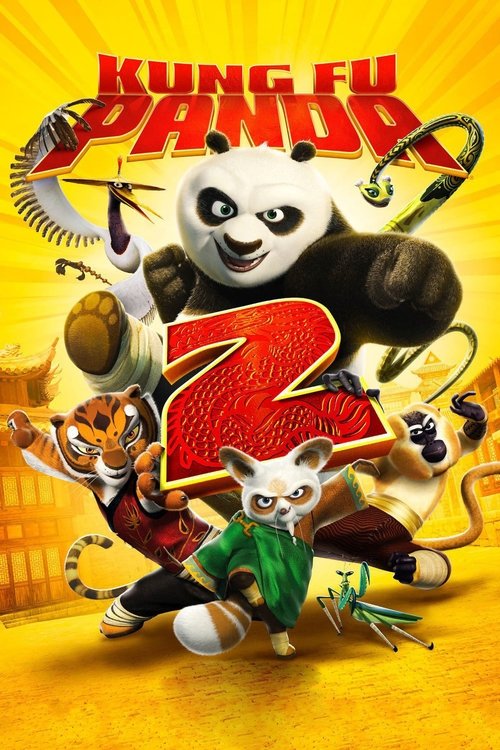
Kung Fu Panda 2 sends Po to confront the truth about his origins — he is adopted, his biological parents unknown — while facing Lord Shen, a peacock who developed a weapon capable of ending kung fu forever. Directed by Jennifer Yuh Nelson (the first woman to solo-direct a major Hollywood animated feature), the sequel deepens Po's emotional world without sacrificing the franchise's spectacle, and its central meditation on whether you can find inner peace while living with unresolved pain is handled with unusual seriousness for a franchise sequel.
Watch for
- The flashback sequences depicting Po's early life, rendered in a deliberately different, more fluid visual style — emotionally raw images that contrast with the film's kinetic action.
- Lord Shen as an antagonist, whose design — a white peacock trailing blood-red tailfeathers — is one of the most visually distinctive villains DreamWorks Animation has produced.
- The film's central emotional question: whether inner peace is possible while living with grief you cannot fully process.
- Jennifer Yuh Nelson's direction, which maintains the franchise's visual scale while adding emotional intimacy not always present in franchise sequels.
- The final scene's reveal that Po's biological father is still alive — a promise of resolution the film does not itself fulfill but commits to honoring — which structures Po's identity arc deliberately across two films rather than resolving it prematurely, demonstrating the franchise's confidence that it had a continuing story worth telling.
Production notes
Jennifer Yuh Nelson became the first woman to receive sole directorial credit on a major Hollywood animated feature — an achievement that went largely unremarked in mainstream coverage at the time but has been extensively acknowledged in subsequent discussions of gender in the animation industry. The flashback sequences depicting Po's early life used a deliberately different animation style — more fluid and impressionistic, closer to ink wash painting — to distinguish memory and trauma from the film's kinetic present-tense action. Gary Oldman voiced Lord Shen, bringing unexpected pathos to a character whose parents cast him out after his obsession with weapons alarmed them, making him someone who spent decades in exile becoming exactly the threat they feared. The film's inner peace meditation was introduced partly as a response to audience feedback that the first film's 'no secret ingredient' resolution, while satisfying, left questions about emotional healing that felt unanswered.
Trivia
- Jennifer Yuh Nelson became the first woman to receive sole directorial credit on a major Hollywood animated feature.
- Gary Oldman voiced Lord Shen and has described the character as one of his favorite voice roles — appreciating how the animation gave the villain's peacock design physical menace.
- The film's inner peace meditation was introduced partly as a response to audience feedback that the first film's 'no secret ingredient' message, while satisfying, left emotional questions unresolved.
- Kung Fu Panda 2 earned $665 million worldwide, outgrossing the original.
- Lord Shen's peacock design was deliberately chosen as a counterintuitive villain species — peacocks are traditionally associated with beauty, display, and preening rather than danger. The production team used that expectation as the basis for the character's visual menace: the blood-red tailfeathers that should be decorative read as threatening, and the animators worked extensively on how a peacock could move with genuine physical danger rather than ornamental presence.
Legacy
Kung Fu Panda 2 earned $665 million worldwide, outgrossing the original, and is often ranked alongside the first film as the franchise's creative peak. Jennifer Yuh Nelson's historic directorial achievement, while underreported at the time, has been recognized as a significant moment in the animation industry's gradual expansion of who gets to direct major studio productions. The film's willingness to engage seriously with adoption, grief, and the possibility of inner peace — not as solved problems but as ongoing work — gave the franchise an emotional depth that the typical blockbuster sequel format rarely permits. The final scene's promise of Po's biological father established a narrative thread honored in the third film, demonstrating unusual creative continuity for a franchise-driven studio.