How to Train Your Dragon
Vibe
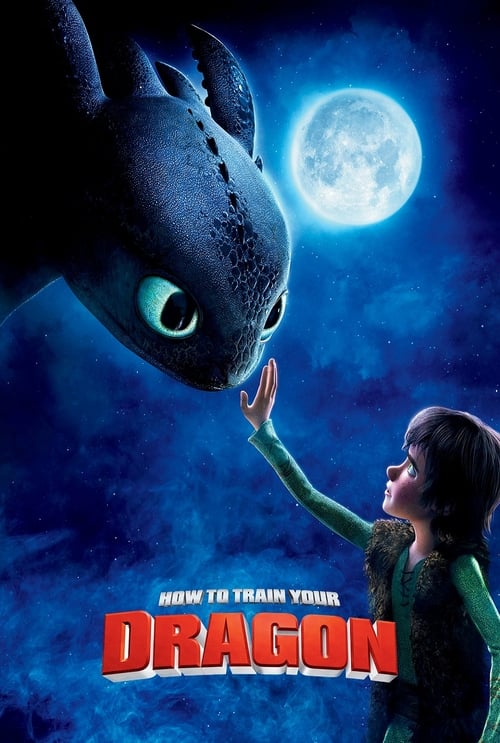
How to Train Your Dragon follows Hiccup, a skinny Viking misfit who injures and then befriends a Night Fury — the rarest dragon alive — and discovers that everything his people believe about dragons is wrong. Directed by Dean DeBlois and Chris Sanders, it is one of the finest DreamWorks Animation productions ever made: a coming-of-age story about the courage to tell the truth when truth is inconvenient, carried by John Powell's extraordinary score and a relationship between Hiccup and Toothless built almost entirely through physical performance rather than words. Its willingness to honor real consequences in its climax sets a standard for narrative integrity that animated films rarely attempt.
Watch for
- The flying sequences, which use sweeping camera work and John Powell's score to generate genuine physical exhilaration — the three-dimensional momentum in these scenes is extraordinary.
- The early scenes in the cove between Hiccup and Toothless, built through cautious physical improvisation rather than dialogue — a pantomime completely convincing in its portrayal of interspecies trust.
- The film's climax and aftermath, which honor real consequences rather than offering a clean resolution — brave in exactly the way animated films rarely are.
- John Powell's score, as important to the film's emotional experience as any element of the animation — the main theme is one of the great animated film compositions.
- Gobber's function as the person who sees both Hiccup and Stoick clearly and cannot make them see each other — positioned as a bridge who ultimately cannot bridge the gap because the two must cross it themselves — giving the film's central father-son conflict a structural sophistication beyond the straightforward generational rebellion premise.
Production notes
Directed by Dean DeBlois and Chris Sanders, who had previously co-directed Lilo & Stitch at Disney. The directors researched the Scottish Highlands and Norway for landscape and atmospheric reference, commissioning specific light studies for the overcast northern sky quality the film needed. John Powell composed the score over approximately three years — an unusually long timeline — during which he traveled to Scotland and met with the production design team multiple times. The relationship between Hiccup and Toothless was developed through intensive study of footage of dogs and their owners, looking for the behavioral vocabulary of interspecies bonding — the tilted head, the cautious approach, the escalating trust demonstrated through small physical offers. The film's climax honors real consequences against significant studio pressure to soften the ending — a decision DeBlois and Sanders made as a condition of their continued creative involvement.
Trivia
- DeBlois and Sanders had previously directed Lilo & Stitch at Disney; their hiring at DreamWorks was one of the studio's most significant creative acquisitions.
- John Powell's score was composed over three years of on-and-off collaboration; the main theme was one of the last elements completed.
- The relationship between Hiccup and Toothless was developed by studying footage of dogs and their owners — the animators looked for specific behaviors like the tilted head and cautious approach that would read as recognizable animal bonding.
- The film received Academy Award nominations for Best Animated Feature and Best Original Score, losing both to Toy Story 3.
- Cressida Cowell's source novel series features a Viking world substantially different from the film's — in the books, Hiccup can speak to dragons from childhood and the relationship is built on language rather than nonverbal trust. The filmmakers decided early that the non-verbal relationship was more cinematically interesting and thematically resonant, making the adaptation more radical than it appears from outside while retaining Cowell's core character relationships and essential warmth.
Legacy
How to Train Your Dragon earned $495 million worldwide and is consistently ranked among the greatest animated films ever made — not just in DreamWorks Animation's output but in the medium's full history. Its two sequels maintained the trilogy's emotional ambition and visual quality in ways most franchise continuations cannot achieve, making the HTTYD trilogy the most consistently excellent animated franchise ever produced. John Powell's score is regularly cited by film composers as among the finest work produced for animation. The film's willingness to honor real consequences in its climax — a decision made against studio pressure — established a standard for animated narrative integrity that the medium continues to struggle to match.