Flushed Away
Vibe
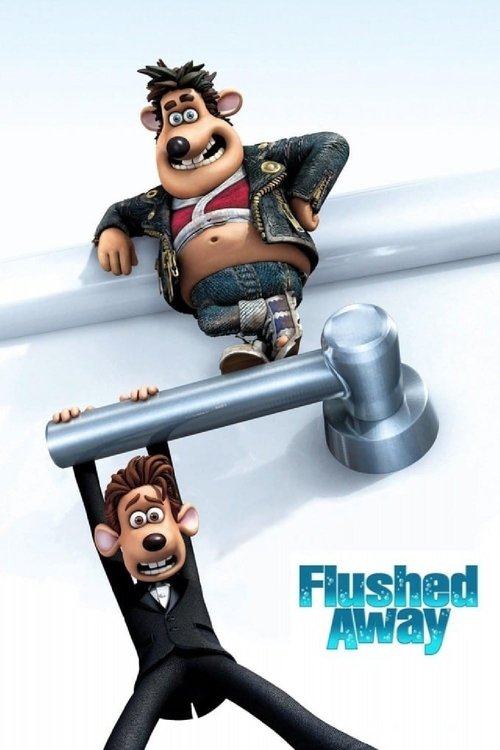
Flushed Away follows Roddy, a pampered pet rat flushed into London's sewers by an intruding rat, who discovers an entire rodent civilization underground and must find his way home. The final Aardman-DreamWorks co-production, directed by Sam Fell and David Bowers, used CGI rendered to mimic stop-motion's tactile quality — a hybrid that produced an unusually textured animated film whose absurdist world-building and wit are distinctly Aardman despite the digital production pipeline.
Watch for
- The singing slugs, who appear as an absurdist chorus throughout — a recurring joke that grows funnier with each appearance.
- The underground London, built from discarded human objects, with its own architecture, class hierarchy, and economy.
- Hugh Jackman and Kate Winslet's vocal chemistry, giving the film's central relationship lightness and warmth.
- Ian McKellen as the Toad, whose elaborate grievance against rats involves a childhood encounter with the Prince of Wales.
- The film's worldbuilding commitment — the underground London's complete economy, class structure, transit system, and history — which treats the rodent civilization as a fully realized society rather than a backdrop for physical comedy, giving the film a depth that rewards the kind of attention most animated comedies don't invite.
Production notes
Aardman's first entirely CGI production, the film deliberately imperfected its rendering to simulate the tactile quality of traditional clay work — surface irregularities, slight color saturation variations, subtle movement imprecisions that give the film a handmade feel despite its digital pipeline. The Aardman-DreamWorks partnership, which had produced Chicken Run and Were-Rabbit, dissolved after the film's commercial performance fell below expectations. Aardman subsequently partnered with Sony Pictures Animation, while DreamWorks lost access to Aardman's distinctly British sensibility. Hugh Jackman and Kate Winslet's vocal performances were largely recorded separately despite the natural chemistry between their characters, with the directors using between-take conversations and improvisations to inform how the recorded lines were ultimately cut together. Ian McKellen approached the Toad's elaborate backstory — social standing destroyed by a childhood encounter with the Prince of Wales — as a character study in aristocratic grievance, delivering villain speeches with the intensity of someone who believed his cause was genuinely just.
Trivia
- This was Aardman's first CGI film; animators deliberately introduced surface imperfections to replicate the tactile quality of traditional clay work.
- The Aardman-DreamWorks partnership ended after this film's performance, with both parties citing creative and commercial differences.
- Ian McKellen approached the Toad's elaborate backstory as genuinely sympathetic — a character whose self-image was destroyed by a childhood incident with royalty.
- The singing slugs were not in the original script; they were added during development and became one of the film's most fondly remembered elements.
- The underground London's design was built as a complete functional city with its own geography, transit system, economy, and class neighborhoods — the production team created detailed maps of the sewer world before beginning any individual scene design, ensuring spatial consistency throughout the film. Specific districts were designated for different rodent classes, with the quality of the discarded human materials used for construction reflecting the resident community's status.
Legacy
Flushed Away earned $178 million worldwide, below expectations, and the dissolution of the Aardman-DreamWorks partnership following the film was one of the more significant events in 2000s animation industry history — ending a collaboration that had produced three critically acclaimed films over eight years. For audiences who have encountered it since its initial release, the film has developed a devoted following as a witty, genuinely Aardman production that was perhaps released into the wrong moment. The singing slugs — added during development and not in the original script — have become its most enduring and fondly referenced element.