Chicken Run
Vibe
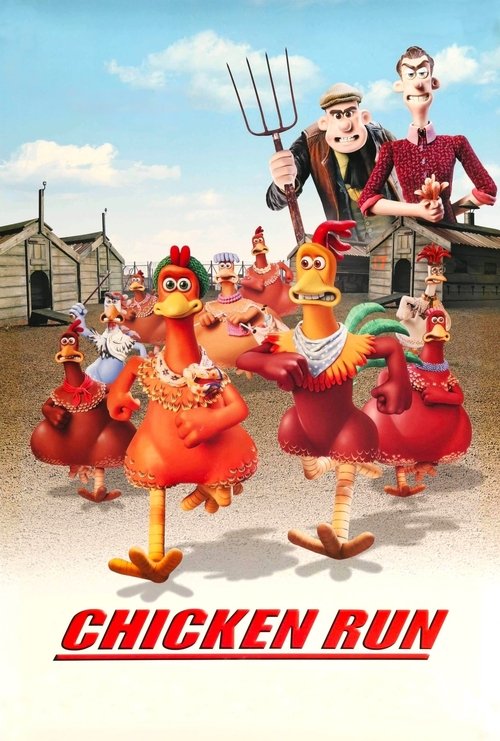
Chicken Run follows Ginger, a hen on a Yorkshire egg farm who has been planning escapes for years with the grim resolve of a prisoner-of-war commandant, and whose latest plan hinges on a crash-landed American rooster who claims he can teach the chickens to fly. An Aardman and DreamWorks co-production directed by Nick Park and Peter Lord, the film is a masterpiece of stop-motion craft that transplants The Great Escape into a barnyard with complete conviction — funny, warm, and constructed with a physical precision that gives every frame tactile life.
Watch for
- Aardman's stop-motion craft at full maturity: every fingerprint in the clay, every hand-sewn costume, every built-by-hand set piece.
- Ginger's characterization as a genuinely strategic, morally clear-eyed hero — one of the most competent female leads in animated film history.
- The escalating escape attempts, each funnier and more elaborately doomed than the last.
- The climactic pie-machine sequence, which is a classically constructed action setpiece that happens to star chickens.
- Rocky's unmasking as a fraud — and the film's decision to let Ginger's betrayal and forgiveness play as genuinely felt rather than as a plot mechanism — demonstrating that the film is as interested in the emotional logic of its characters as in its genre parody, and that the Great Escape structure is scaffolding for real character work rather than the point itself.
Production notes
A co-production between Aardman Animations in Bristol and DreamWorks Animation, directed by Nick Park and Peter Lord, who had spent nearly two decades developing the Aardman aesthetic through short films before attempting a feature. The physical production required multiple sizes and configurations of every character — approximately 30 different physical Ginger puppets alone — and constructing every set, prop, and costume entirely by hand. Park and Lord screened The Great Escape multiple times at the start of production, storyboarding specific compositional references they wanted to honor. Mel Gibson voiced Rocky, then a major Hollywood casting for an animated feature; the remainder of the cast was primarily British character actors whose voices carried the film's distinctly English comic register. At peak production, hundreds of animators were working simultaneously across multiple physical stages at Aardman's Bristol facility, maintaining spatial and continuity consistency across months of filming. The film's $45 million budget was small for a major studio animated feature, making its $224 million worldwide gross one of the most efficient returns in DreamWorks Animation's history.
Trivia
- The film required approximately 30 different physical Ginger puppets, each sized or configured for different shot requirements.
- Nick Park and Peter Lord screened The Great Escape multiple times at the start of production to establish the film's structural and visual language.
- Chicken Run became the highest-grossing stop-motion animated film of all time upon its release, a record it held for many years.
- The pie machine in the climax was a practical mechanical prop built entirely by hand by the Aardman crew.
- Nick Park and Peter Lord insisted on maintaining Aardman's traditional clay-and-wire stop-motion technique against pressure to incorporate CGI elements — the only digital assistance used was in post-production compositing. The decision preserved the film's distinctive tactile quality and required an unusually large physical crew, with the production commissioning new clay formulations specifically to hold detail under the heat of the production lights.
Legacy
Chicken Run earned $224 million worldwide on a $45 million budget — one of the most efficient returns in DreamWorks Animation's history — and remains the highest-grossing stop-motion animated feature ever produced. It proved definitively that handmade stop-motion could compete commercially with the CGI films dominating the market in 2000, and Nick Park's subsequent Wallace & Gromit feature was made possible by the credibility and commercial goodwill this film generated. In retrospective rankings of animated comedy, Chicken Run appears with remarkable consistency near the top — a film whose craft, warmth, and structural intelligence have only become more apparent as its influences have faded and its own work remains fresh.